Contemporary architecture has changed the way the kitchen is understood. It is no longer only about designing a working area, but about creating a space capable of organising domestic life, connecting rooms and giving material continuity to the interior project.
Blade is a Modulnova kitchen conceived through matter, proportion and volume. Its design is based on large functional islands, linear fronts and continuous surfaces that allow the kitchen to become part of the domestic space without turning it into a closed room.
The collection is built around a clear idea: the kitchen can act as an architectural element within the home. It does not appear as a set of independent units, but as a system capable of structuring the space, defining movement and creating a natural relationship between work, daily life and representation.
The Blade kitchen is defined by a linear, sober and strongly material image. Its compositions can be adapted to the needs of each project, while maintaining a recognisable identity: clean planes, defined volumes and a precise reading of the junctions between surfaces.
This way of understanding the kitchen works especially well in interiors conceived as a continuous sequence. Blade does not need partitions to establish its presence. The island itself, the fronts and the changes in texture organise the space clearly.
Rather than separating, it articulates.
The Blade island is not simply a work surface. Its scale and visual weight turn it into a central volume within the interior composition. It can support preparation, cooking, gathering and everyday use, but its importance goes beyond function.
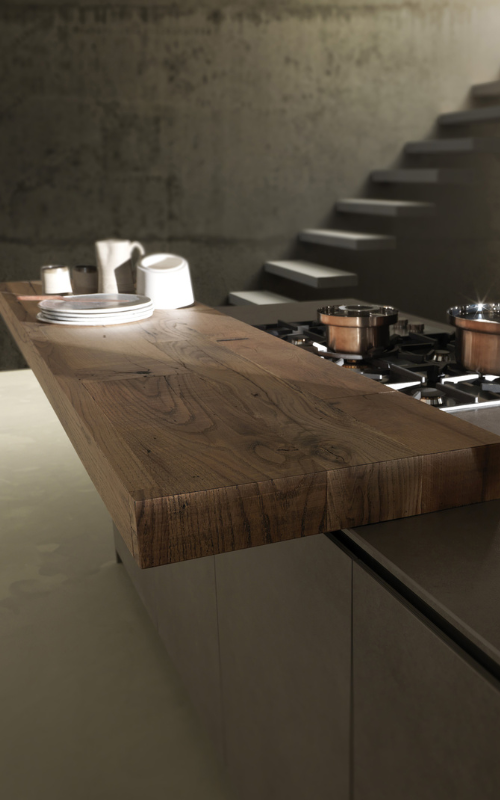
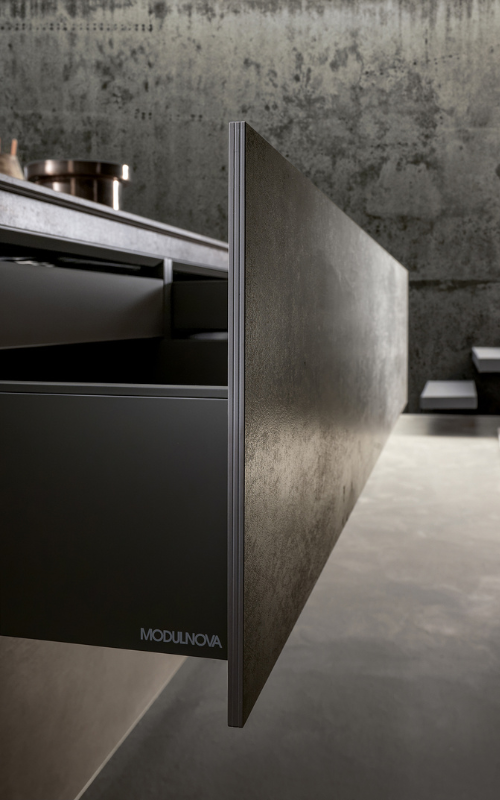
Piasentina stone, finished with the millerighe texture, introduces a deep and recognisable surface. The material gains relief, shadow and rhythm. It is not a decorative finish added at the end of the project, but a material presence that contributes to the visual construction of the space.
In an open kitchen, this presence becomes especially relevant. The island defines the kitchen area without interrupting its relationship with the living room or dining area. It creates a boundary, but not a barrier.
The combination of Piasentina stone and Black Metal reinforces the architectural character of Blade. Stone brings density, texture and a sense of permanence. The dark finish introduces a more technical, precise and contemporary reading.
The contrast between both materials allows the volume to be perceived more clearly. The surfaces do not compete with each other; they complement each other. Stone builds depth. Metal sharpens the profiles. The result is solid, but not heavy.
This is one of the key qualities of a well-designed high-end kitchen: sophistication does not depend on excess, but on proportion, materiality and the precision of detail.
Blade responds to a way of living in which the kitchen is no longer a secondary room. In many contemporary homes, kitchen, dining area and living room share the same surface. This requires systems that can organise the space without dividing it into closed compartments.
The collection makes it possible to subdivide the kitchen area functionally while preserving the visual continuity of the whole. Linear fronts and refined surfaces help the composition integrate into the space without losing its own character.
This quality is particularly valuable in interior design projects where the kitchen must remain in dialogue with other uses. Blade can act as a transition, as a central piece or as a volume that gives structure to the entire composition.
A contemporary kitchen cannot be designed only from an aesthetic point of view. It also has to respond to daily use, circulation, storage and the different ways of living in the home.
Blade allows for large work surfaces and specialised cooking areas, including more distinctive solutions such as a grill station. These resources expand the functional dimension of the kitchen without altering the sobriety of the design.
Matter does not hide function. It organises it.
Every plane has a role within the whole. Every volume responds to a specific need. The kitchen becomes an active space, ready for cooking, gathering and participating in domestic life without losing formal coherence.
Blade represents a way of understanding the kitchen as part of the architectural project. The island is no longer an isolated element, but a volume. The fronts are no longer simple doors, but part of a continuous surface. Materials no longer act merely as finishes; they build atmosphere.
This relationship between matter, use and proportion is what connects Blade with contemporary architecture. Its value does not lie in looking spectacular, but in organising space with precision, integrating complex functions and creating a calm material presence within the home.