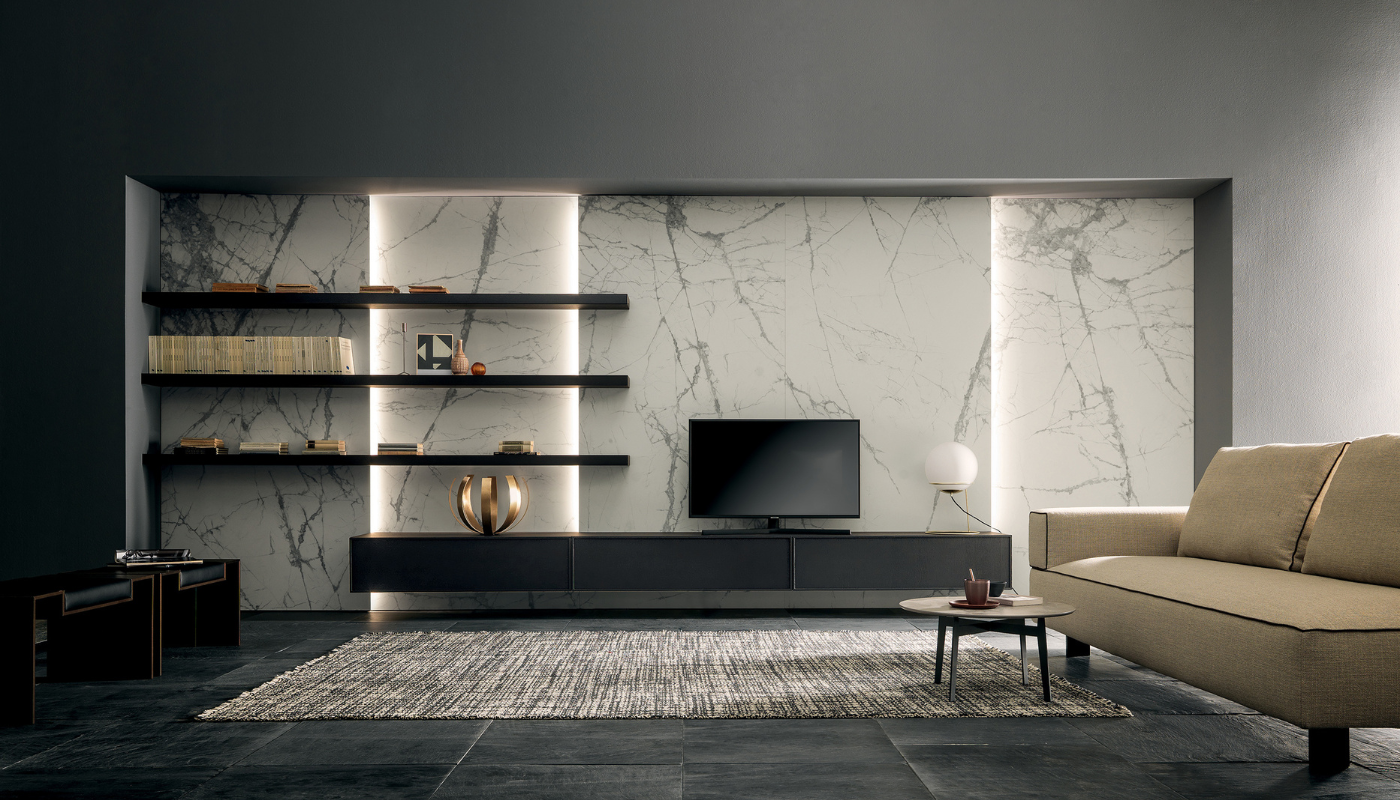
Frame organises the living room through balanced proportions, defined profiles and materials capable of creating continuity. The Modulnova collection brings the language of the framed door into the contemporary living space, turning furniture into part of the interior architecture.
Frame is characterised by a slim framed door with a handle integrated into its perimeter. This detail structures the composition and gives it a recognisable identity based on linearity and measured proportions.
Within the living room, this language allows storage and supporting surfaces to be conceived as part of a shared structure. The individual elements are no longer perceived as isolated pieces of furniture, but as a continuous architectural background.
The frame is the collection’s principal formal feature. It outlines the door, incorporates the opening system and makes the proportions of each front clearly visible. Its repetition introduces order without turning the composition into a rigid surface.
In the kitchen and bathroom collections, Modulnova develops doors with restrained frame thicknesses and handles either recessed into or formed from the perimeter. Applied to the living room, this principle reduces the presence of added components and preserves the visual continuity of the equipped wall.
Proportion is one of the central principles of Frame. In the kitchen, it is expressed through the horizontality of a large island, contrasted with tall units that recall wardrobes from the 1950s. In the living room, the same logic can be translated into low units, suspended elements and taller volumes.
Horizontal planes visually extend the composition. Vertical elements add storage capacity and rhythm, preventing the overall arrangement from being perceived as a single continuous band.
Modulnova also uses fronts that project beyond the sides of the cabinet. This solution reduces the apparent weight of the volume: the separation between planes creates shadow, depth and a greater sense of lightness.
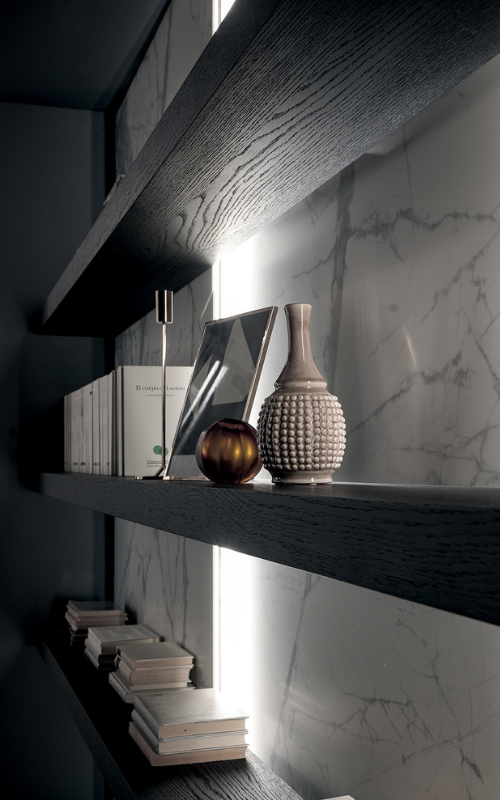
Frame combines materials with distinct visual qualities. Gloss lacquer introduces reflection. Porcelain stoneware brings a mineral presence. Smoked oak adds texture, chromatic depth and a clearly recognisable grain.
The collection also works with Carrara and Sahara Noir porcelain stoneware, alongside metallic finishes such as Bronze Dust. Carrara enhances luminosity when contrasted with darker tones. Sahara Noir introduces a pronounced veining pattern, while Bronze Dust emphasises the outline of the frame.
Light surfaces expand the perception of brightness; dark stone draws the eye; wood introduces warmth; metal sharpens the profiles.
Frame makes it possible to understand the living room wall as an integrated structure capable of organising the space while maintaining a balanced relationship with the surrounding architecture.
Tall units form continuous volumes, while suspended elements introduce horizontal lines and areas of reduced visual weight. Variations in height and depth prevent the composition from appearing flat and allow the system to adapt to the proportions of the interior.
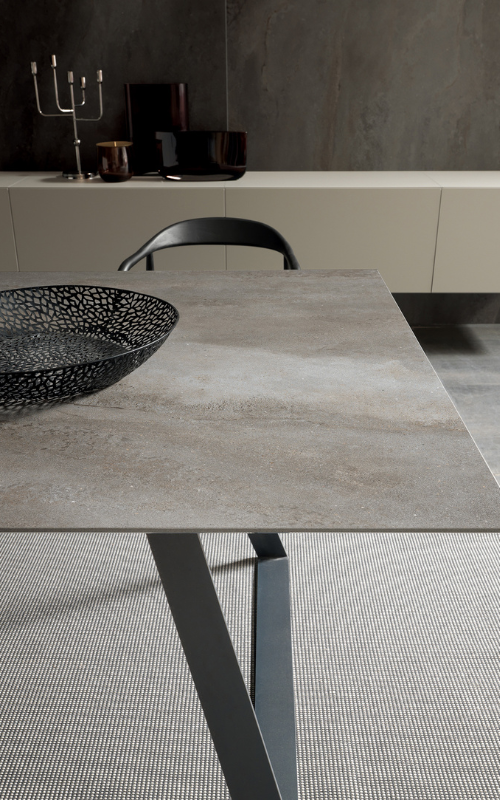
In open-plan spaces, the repetition of materials and profiles can connect the living room, dining area and kitchen without confusing their respective functions.
Frame organises without enclosing.
The contemporary living room must accommodate storage and different forms of use without losing visual clarity. Frame integrates these needs within a coherent composition, where closed fronts contain everyday objects and open planes create pauses.
Lighting can reinforce changes in depth and make material textures more visible. Modulnova uses side lighting and backlighting to enhance porcelain stoneware and wall panelling; applied to the living space, this principle highlights the relationship between surfaces.
The integrated handle completes this functional approach. Recessed within the frame, it preserves the clean appearance of the front while supporting comfortable everyday use.
Frame draws on familiar references such as 1950s wardrobes, framed doors and traditional wall panelling. These elements are reinterpreted through slim profiles, concealed handles, suspended units and contemporary material combinations.
Memory is expressed through proportion and the construction of the front, rather than through the literal reproduction of a historical style. This allows Frame to integrate into both classical architecture and more restrained contemporary interiors.
The collection proposes a living room designed around permanence. The frame defines the rhythm, the volumes organise the wall and the materials create depth. Frame therefore turns interior design into a precise structure that connects memory, function and interior architecture.