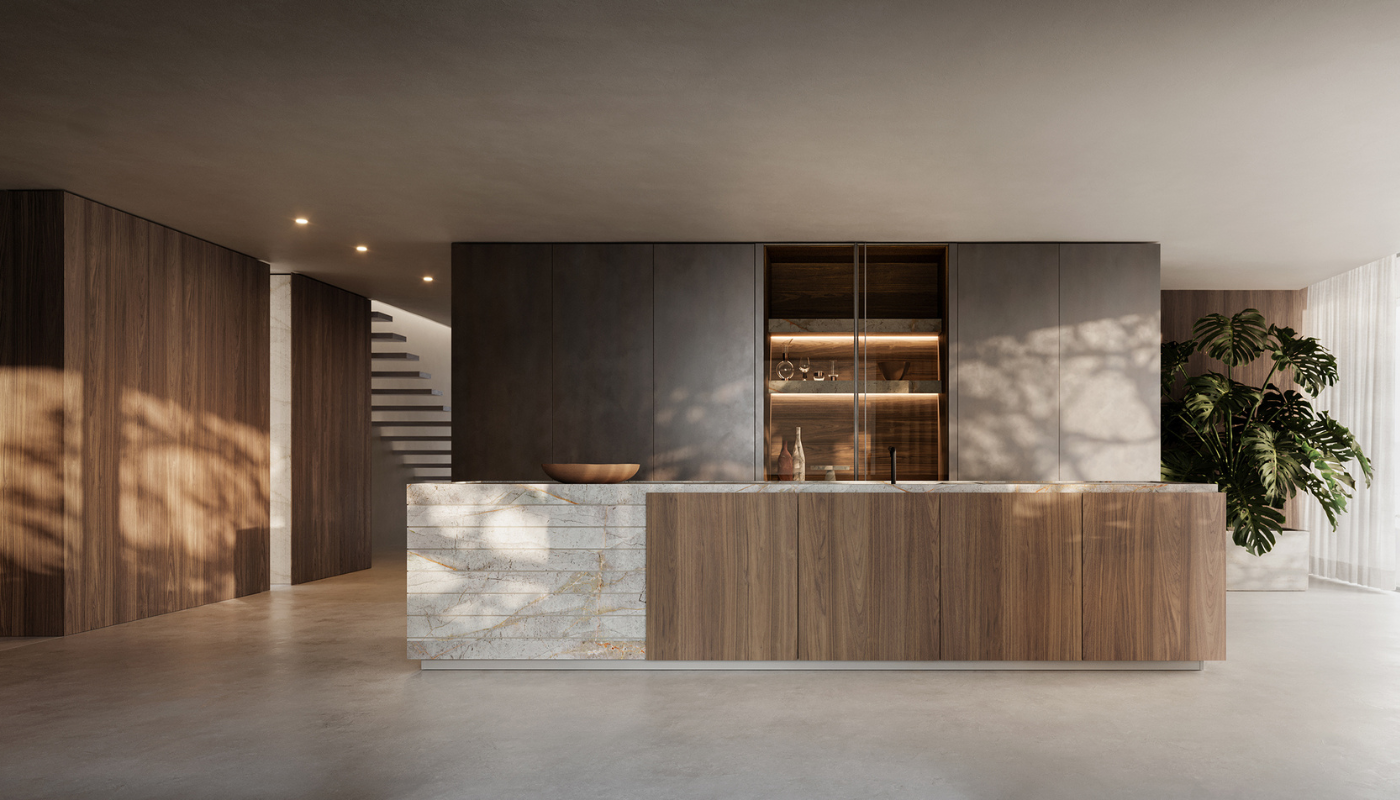
The contemporary interior kitchen is becoming an integral part of the home’s architecture, acting as a structure capable of organising functions, circulation and visual relationships. ART by Modulnova develops this idea through a precise composition of Appennino stoneware and Classic walnut, where material defines both volume and the everyday experience of the space.
ART is a kitchen collection built around the meeting of a monolithic mineral surface and wood crafted to preserve material continuity. The island, fronts and storage elements form a unified system in which every technical detail contributes to a clear architectural reading.
The collection does not rely on ornament. Its identity comes from the proportion of its volumes, the continuity of the grain, the 45-degree joints and the integration of openings, profiles and lighting.
The ART kitchen is characterised by clean lines and substantial volumes. Appennino stoneware forms the central body, while oiled Classic walnut introduces warmth, depth and a more human scale.
Both materials retain their individual character, yet they are connected through carefully resolved junctions. Stone creates the impression of a continuous mass. Wood wraps around part of the island, extends its grain across different planes and softens the presence of the mineral block.
This relationship allows the kitchen to be perceived as an element integrated into the interior architecture. The modules do not appear as separate pieces of furniture, but as parts of a continuous structure that organises the space and reduces visual interruptions.
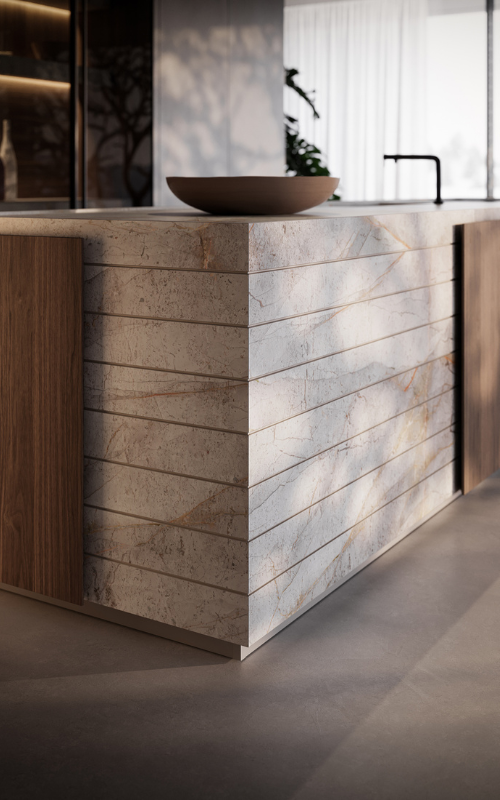
The ART island carries much of the spatial weight of the composition. Its Appennino stoneware finish reproduces the appearance of marble from the Apennines and creates a homogeneous surface around the working volume.
The monolithic effect is achieved through a 10-centimetre-thick worktop and a 45-degree junction between the side panel and the dogati back panel. This solution reduces the presence of visible joints and allows the different faces to be read as a single mineral envelope.
The worktop is slightly raised above the structure and incorporates a containment edge on all four sides. This functional detail helps contain liquids and protects the perimeter without introducing elements that disrupt the overall geometry.
The scale of the island allows it to organise the room. In open-plan interiors, it can define the kitchen area without partitions, establish circulation distances and create a clear transition towards the dining or living area.
The kitchen is defined by the volume itself while preserving the visual continuity of the interior.
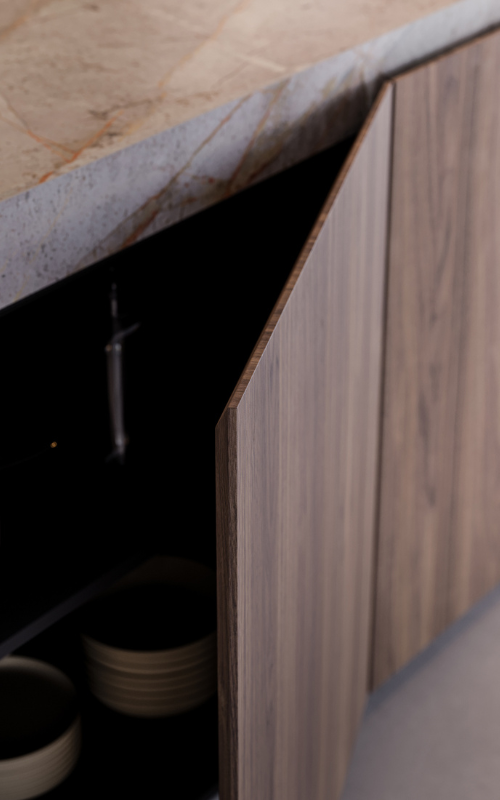
Wood introduces a different reading within the ART system. The Classic walnut doors are produced using the folding technique, allowing the finish to continue across the front, edges and inner face.
Each door is 3 centimetres thick, angled at 30 degrees and set back 4 centimetres from the upper surface. This geometry creates depth and precisely defines the junction with the stoneware volume.
The vertical grain continues uninterrupted across the edge, profile and inside of the door. Material coherence is therefore maintained both when the fronts are closed and when they are opened and used.
The walnut doors partially wrap around the Appennino stoneware island and cover part of its corners. This gesture links the two materials and creates a mirrored effect between the facing surfaces. Wood does not act merely as a chromatic contrast, but as a skin that follows and completes the central block.
In ART, materials directly influence the perception of the kitchen. Stoneware reinforces the horizontality of the worktop and gives the composition visual density. The vertical grain of the walnut introduces rhythm and height.
The contrast between the two surfaces helps organise the whole. The mineral finish draws attention to the island and the working area. Wood constructs the vertical planes and relates the kitchen to other interior elements, such as wall finishes, furniture and joinery.
This combination also changes the way light moves through the space. Stoneware presents a precise, continuous surface, while walnut reveals variations in tone and texture. The interior architecture gains depth through the behaviour of the materials themselves, without requiring separate decorative elements.
ART incorporates the Glass programme in its entrance-door version, expanding the layout possibilities and allowing the kitchen to connect with auxiliary spaces.
The Anthracite Dust frame is integrated and concealed within a single vertical profile, which also acts as a handle. The opening system is resolved without additional handles, preserving the visual simplicity of the fronts.
Inside the display cabinet, a Classic walnut structure is combined with shelves and two suspended Appennino stoneware bases. These elements appear to float within the volume, supported by their visual lightness and the lighting integrated into the shelves.
The integrated lighting improves visibility and highlights the grain of the wood and the texture of the stoneware. Storage becomes part of the kitchen’s material composition and receives the same attention to detail as the island and main fronts.
ART’s formal clarity depends on specific technical solutions. The 45-degree joints, folding technique, integrated vertical profile and containment edge resolve everyday use without fragmenting the overall image.
Each element has a recognisable purpose. The island provides working and support surfaces. The walnut fronts organise storage. The Glass programme introduces an architectural transition and an illuminated display cabinet. Everything is integrated within a composition in which openings and equipment remain visually controlled.
This precision prevents functionality from creating visual noise. The kitchen retains an ordered appearance even when it integrates different operational zones, storage volumes and connections with other rooms.
ART approaches the kitchen as a system shaped by material, proportion and continuity. Appennino stoneware creates a solid central volume; Classic walnut wraps around it, introduces depth and brings a warmer presence; and the Glass programme extends the composition through an integrated access and storage solution.
The collection finds its expression in visible details: the thickness of the worktop, the continuity of the grain, the angle of the doors, the 45-degree joints and the lighting incorporated into the shelves.
ART represents a contemporary interior kitchen in which technique and material form part of the same structure. Its design organises the space with precision and makes the relationship between stone, wood and light the central theme of the project.